Have you ever wondered why every news channel seems to say the same thing? It often feels like we are all being told what to think. This is exactly what the famous book Manufacturing Consent talks about. Written by Edward S. Herman and Noam Chomsky, this book changed how we look at the world. Many people search for a manufacturing consent pdf to understand the “Propaganda Model.”
In this article, we will break down the big ideas from the book into simple steps. We will look at how the media works behind the scenes. You don’t need to be a professor to understand this! We will use easy words to explain how powerful groups “manufacture” our agreement on big issues. Whether you are a student or just curious, this guide is for you.
The Brilliant Minds Behind the Book
Before we dive into the details, let’s meet the authors. Noam Chomsky is a very famous thinker and linguist. Edward S. Herman was an expert in finance and media. Together, they realized that the media in democratic countries doesn’t use a “big stick” like a dictator does. Instead, it uses subtle filters to guide our thoughts (Herman & Chomsky, 1988).
They published the book in 1988, and it is still a bestseller today. Their goal was to show that news is not just “facts.” It is a product made by companies. Just like a factory makes a car, the media makes “consent.” This means they help us agree with what the government and big companies want to do.
What Exactly is the Propaganda Model?
The Propaganda Model is the heart of the book. It explains how “brainwashing under freedom” happens in places like the United States (Herman & Chomsky, 1988). Usually, we think of propaganda as something only bad countries use. But Chomsky and Herman argue that it happens in free countries too.
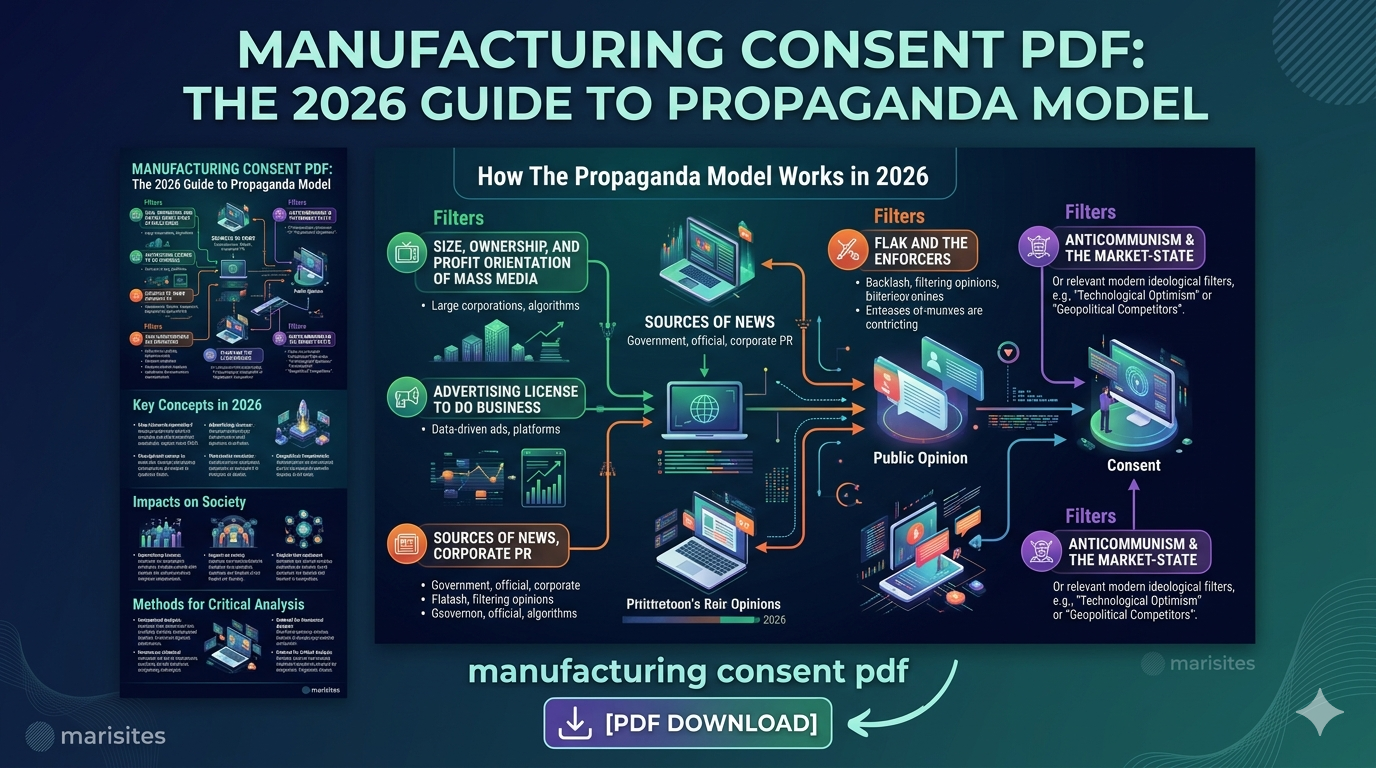
The model suggests that news passes through five filters. These filters remove anything that might hurt the people in power. By the time the news reaches your TV or phone, it has been cleaned up. It only shows what the “elites” want you to see. This isn’t a secret conspiracy; it’s just how the system is built to work (Herman & Chomsky, 1988).
The Size and Wealth of Media Companies
The first filter is all about money and ownership. Most big news sites and TV channels are owned by giant corporations (Herman & Chomsky, 1988). These companies have one main goal: to make a profit. Because they are so big, they share the same interests as other big businesses and the government.
They are not likely to report news that makes big corporations look bad. If a news story might hurt the stock price of the parent company, it might get buried. This filter ensures that the “bosses” of the world stay happy. It’s hard to be a watchdog when the person you are watching owns your paycheck!
The Power of Advertising
Have you noticed how many ads are on news sites? That is because news is not free to produce. The second filter is advertising. Most media companies get their money from advertisers, not from readers. This means the advertisers are the real “customers,” and the readers are the “product” being sold (Herman & Chomsky, 1988).
If a news station reports something that upsets a big advertiser, that advertiser might leave. To keep the money flowing, the media often creates a “supportive selling environment.” This means they avoid stories that are too radical or that question the consumer lifestyle.
Filter 3: Where the News Comes From (Sourcing)
News reporters need stories every day. But they can’t be everywhere at once. So, they rely on sources. The third filter is about who provides the info. Most news comes from government offices, police departments, and big business PR teams (Herman & Chomsky, 1988).
These sources are seen as “objective” and “reliable.” However, they often have their own agendas. Because the media needs a steady stream of news, they don’t want to upset these sources. If a reporter asks too many tough questions, they might lose their access. This makes the media a “conduit” for official government views (Robertson & Williams, n.d.).
The Fear of “Flak”
What happens if a journalist tells a truth that the powerful don’t like? They get flak. Flak refers to negative reactions like lawsuits, complaints, or nasty phone calls from important people (Herman & Chomsky, 1988). Think of it like a “defense mechanism” for the system.
There are even “flak machines”—groups funded by billionaires specifically to attack journalists who go off-script. Because flak is expensive and annoying, many media outlets simply avoid controversial topics altogether. They stay in the “safe zone” to avoid the headache of being attacked.
Creating a Common Enemy
The final filter is about having a boogeyman. When the book was written, this was “Anti-Communism.” Today, it might be “Terrorism” or a specific “Evil Dictator” (Herman & Chomsky, 1988). This filter helps mobilize the public against a common threat.
By focusing on an external enemy, the media can justify wars and high taxes. It also makes anyone who disagrees look like a “traitor” or “unpatriotic.” This filter creates a “we vs. them” mentality. It stops people from questioning the problems happening right here at home.
Why the Manufacturing Consent PDF is Still Relevant
Even though the book is decades old, the manufacturing consent pdf is more popular than ever. Why? Because the internet has changed things, but the filters are still there. In fact, some people argue the filters are even stronger now (Herman, 2020).
Today, algorithms on social media act as a new kind of filter. They show us what we want to see, which can keep us in bubbles. The lessons from Chomsky and Herman help us stay sharp. They teach us to ask: Who paid for this story? Who does it benefit? Who is being left out?
Conclusion
Understanding how the media works is like getting a pair of “truth glasses.” Once you see the filters, you can’t unsee them. Manufacturing Consent isn’t about being cynical; it’s about being a better citizen. It encourages us to look for independent news and to think for ourselves.
Don’t let the “propaganda model” decide what you believe. Start by reading different viewpoints and supporting independent journalists. The power to change the world starts with the power to see it clearly.
FAQs
1. Is “Manufacturing Consent” a conspiracy theory?
No. The authors say it is a “structural analysis.” It doesn’t require a secret meeting of elites; it’s just how the business of media works naturally (Herman & Chomsky, 1988).
2. Where can I find the Manufacturing Consent PDF?
You can find it on many educational sites and digital libraries like Libcom or the Internet Archive. Always look for legal and safe versions.
3. Has social media stopped the propaganda model?
Not exactly. While we have more voices, big companies still control the platforms and the ads, which means the old filters have just taken new forms (Herman, 2020).
4. What are the “Five Filters” in simple terms?
They are: Ownership (who owns the media), Advertising (who pays for it), Sourcing (where info comes from), Flak (attacks on reporters), and Fear (creating a common enemy).
5. Can I trust any news at all?
Yes, but you should be “media literate.” This means checking sources, looking for bias, and reading independent reports alongside mainstream ones.
6. Who wrote the original book?
It was co-authored by Edward S. Herman and Noam Chomsky and first published in 1988.
References
- Herman, E. S., & Chomsky, N. (1988). Manufacturing consent: The political economy of the mass media. Pantheon Books.
- Cited by: 15432
- Herman, E. S. (2020). The propaganda model revisited. The Jus Semper Global Alliance. https://jussemper.org/Resources/Democracy%20Best%20Practices/Resources/EdwardHerman-PropagandaModel.pdf
- Robertson, K., & Williams, A. (n.d.). Mass media – Agenda-setting theory and the propaganda model. Insights into Communication Studies. https://pressbooks.openeducationalberta.ca/insightsintocommstudies/chapter/chapter-8-mass-media/
Leave a Reply